Jeeni Blog

Helping the next generation of talent to build a global fanbase

Global Online Music Streaming Grew 32% to over 350 Million Subscriptions in 2019

/ By
Global Online Music Streaming Grew 32% to over 350 Million Subscriptions in 2019

By Abhilash Kumar

  • Spotify continues to be the market leader and recorded a 23% YoY growth in total revenue during CY 2019.
  • Music streamers are focusing on creating exclusive content with podcasts continuing to feature strongly in 2020.

Seoul, Hong Kong, New Delhi, Beijing, London, Buenos Aires, San Diego – 3rd April 2020

Global online music streaming subscriptions grew 32% year-on-year (YoY) reaching 358 million subscriptions in CY 2019, according to the latest findings from Counterpoint Research. This is driven by the availability of exclusive content like podcasts, originals which attracted people towards the platform and eventually turned them as subscribers. Also, promotional activities like price cuts in subscriptions in emerging markets, bundled offers from telcos added to the growth. We expect that online music streaming subscriptions to grow more than 25% YoY to exceed 450 million subscriptions by the end of 2020.

Commenting on the overall market, Research Analyst, Abhilash Kumar, said, “Paid subscriptions grew 32% YoY compared to 23% YoY growth of total MAUs. This suggests people are ready to pay for music streaming for a hassle-free experience.  However, this is not completely user-driven. Music streaming platforms are following a two-step approach to gain subscribers, first registering them to their platform as free users by means of excellent advertising campaigns and secondly pitching them with attractive offers to transfer them to become paying subscribers.”

Spotify topped CY 2019 grabbing a 31% share of the total revenue and a 35% share of the total paid subscriptions. The runner up, Apple Music, follows with a 24% share of total revenues in the industry and a 19% share of the total paid subscriptions. Due to Apple’s high focus on its services segment which includes Apple Music, its subscription base grew 36% YoY in CY 2019. Amazon Music subscriptions reached a 15% share in 2019 compared to 10% in 2018.

Talking about the top performers, Kumar added, “Spotify maintained its top spot with the help of promotional activities like free Spotify Premium for three months, price cuts, customized campaigns like Spotify and a focus on exclusive content. Tech giants like Amazon, Apple, Google have started focusing on music streaming and have sufficient cash at their disposal to give stiff competition to Spotify. Apple Music is making improvements in its app like the introduction of night mode, curated playlists to target a group, etc. Similarly, Amazon Music has been trying lossless music and is creating its own niche where it competes with Tidal.”
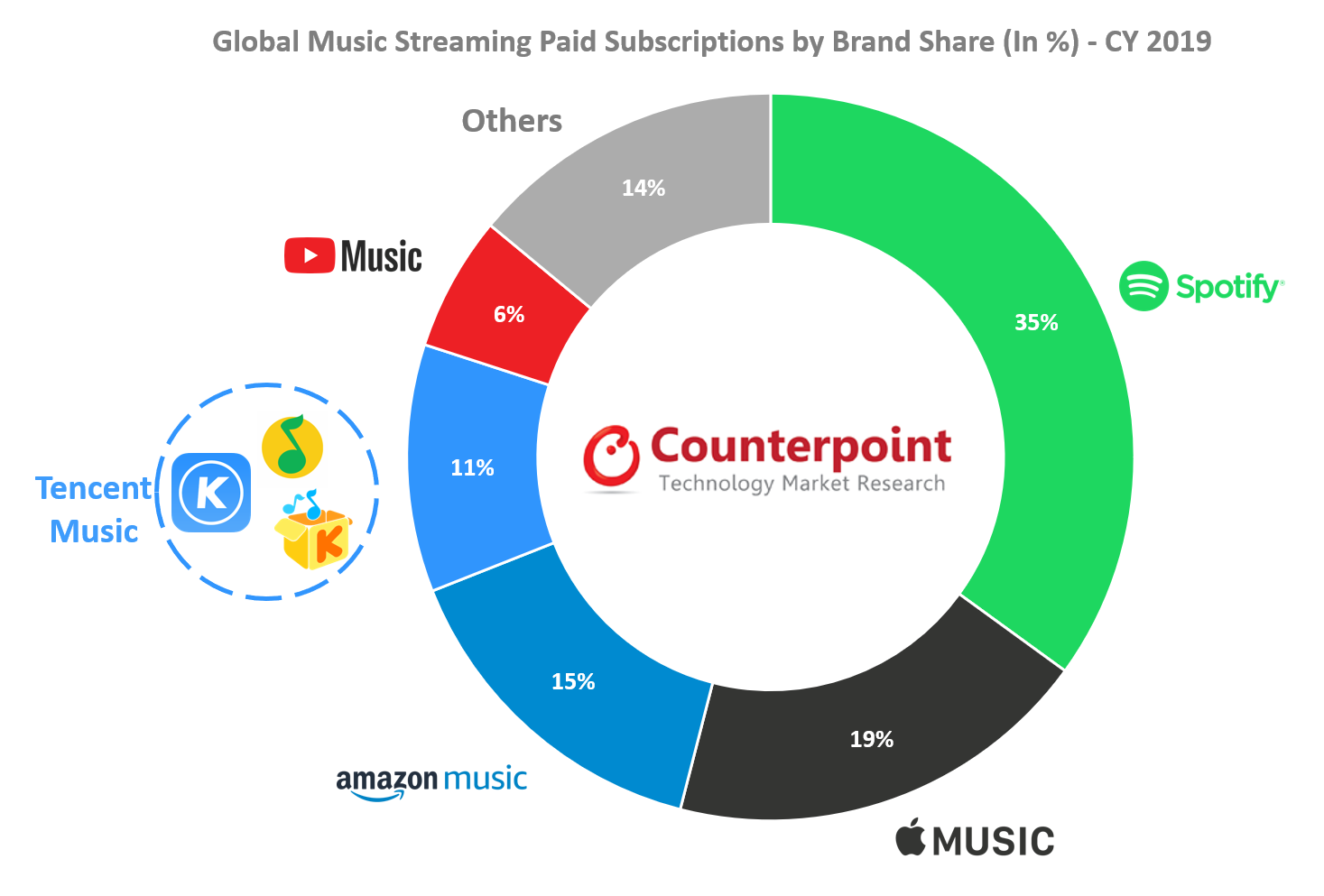
Counterpoint: Global Music Streaming Paid Subscriptions by Brand Share

Despite global players strongly pushing their music streaming platforms, regional players stand strong in their respective regions, primarily because of regional exposure and high focus on local content. Gaana continues to be the no.1 player in the Indian market, Yandex Music is leading in Russia. Similarly, Anghami leads the Arab world. Tencent Music Group leads the China market with the help of its apps QQ Music, Kugou and Kuwo.

Discussing the impact of the COVID-19 pandemic on the OTT industry, Kumar added, “We expect the OTT sector will experience an uptick as people stay at home actively tracking the latest updates. During this outbreak, audio OTT consumption has switched from music streaming to the radio. People in highly affected areas are worried about the outbreak and are therefore continuously tuned to news on TV/radio for updates. The traction of news channels and podcasts saw an upswing while that for music streaming dropped.”

What’s common is that both the regional and global players are focusing a lot on building exclusive content. Acquiring podcast companies and creating their own channels are all being undertaken. It’s often exclusive content that drives paid subscription growth.

More than 80% of music streaming revenue came from paid subscriptions. The rest came from advertisements and partnerships with brands and telcos. Therefore, increasing paid subscriptions is of prime importance for music streaming platforms.

The comprehensive and in-depth chain of reports on Global Online Music Streaming Market for Q4 2019 is available to help track the market in terms of MAUs by region, paid subscriptions by region, revenues, and ARPU. To view the global report in terms of users, revenues and ARPU, click here. For regional analysis on MAUs and paid subscriptions, click here. Please contact press(at)counterpointresearch.com for further questions regarding our in-depth research, insights or other press inquiries.

Background:

Counterpoint Technology Market Research is a global research firm specializing in Technology products in the TMT industry. It services major technology firms and financial firms with a mix of monthly reports, customized projects and detailed analysis of the mobile and technology markets. Its key analysts are experts in the industry with an average tenure of 13 years in the high-tech industry.

Click HERE to visit or return to jeeni.com

01
Jul

Zeeteah Massiah - ‘Bad Guy’ Single Review

Zeeteah’s newest release is a genius reggae reimagining of Billie Eilish’s breakthrough hit, ‘Bad Guy’.  Jeeni ambassador and long-term supporter, Zeeteah Massiah has now provided Jeeni with 21 individual pieces of her unique brand of jazz and reggae, all of which are available at her showcase. Her husband, Paul Caplin acts as both songwriter and producer for Zeeteah and the two of them have released two albums together, ‘Juice’ and ‘Maybe Tomorrow’.   A certain level of musical depth and understanding is needed to undergo a stylistic transformation of an existing song. To some, it’s merely a process of downgrading the intensity and presence of the piece to a slow, acoustic setting. However, in a lot of these cases, the essence and arrangement of the pieces are largely unchanged. On the other end of that spectrum of effort and passion, you’ll find artists like Zeeteah Massiah who listened to the ‘Old Town Road’ dethroner and heard a hidden stylistic potential held in Billie’s hit that she knew would effortlessly make sense to any listener.  Zeeteah set out to not just echo Billie’s Grammy-winning hit in a slightly different accent, but instead, wanted to transpose it into a completely different musical language. The result is a rejuvenated and refreshing take on ‘Bad Guy’ that has a vivid coat of Caribbean-styled paint applied to just about every element of the source material. Where the original was dark, somber yet playful, Zeeteah’s keeps just the playfulness for her rendition. The slow, creeping tempo compliments the lyrics and performance from Zeeteah in a way that could make you think that this might actually be the original. This almost sinister embrace of the villainous title is enhanced by the harmony that dips in and out of jazzy minor chords that keep the listener in a subtle state of unsettlement, and curiosity.   As is to be expected from Zeeteah and her artistic proclivities, bright and colourful instrumentation commands the tone of this arrangement. Being the first component heard; a classic reggae drum roll makes the genre-shift immediately apparent. This Caribbean staple is then joined by its good friends; short offbeat guitar stabs and deep, bouncy basslines. In this introduction, we also hear a brilliant alteration from Billie and Finneas’ original arrangement. The quirky, recognisable synth melody heard after Billie’s isolated ‘Duh!’ is instead taken up by a muted trumpet, heard before the vocals even enter. This is a clever embrace of the fact that Zeeteah’s choice of cover is of course a colossal hit, so there’s no sense in shying away from its most recognisable moments. That melody is also expanded on later for a phenomenal trumpet solo towards the end of the cover that acts as a sort of replacement for the sudden shift in pace, heard at the end of the original.  Considered a part of Billie Eilish’s brand as both a performer and a person, her vocals are often intentionally sleepy and low-energy, something that Zeeteah decided not to adopt for her interpretation. The vocal performance here is mischievous and rebellious to the core as opposed to Billie’s more disinterested and indifferent approach. Zeeteah also uses next to no effects on her voice compared to the first version, which is just as well because it would be a shame to distract from the raw talent and personality held in Zeeteah’s performance on ‘Bad Guy’.  This task of reinventing one of the biggest hits from the last 10 years was a tall order, however, unsurprisingly, Zeeteah Massiah’s ‘Bad Guy’ is nothing but a triumph. 

12
Mar

Live Virtual Gigs in the Gaming Metaverse

In November last year, a live virtual gig took place in the gaming Metaverse of world platforms. Rapper Lil Nas X took to the stage in Roblox, and performed in a free-to-view event, which broke all previous records to become one of the the most viewed concerts of all time, pulling in a worldwide record-breaking audience of over 35-million visits. Lil Nas X's Virtual Gig - Credit: Still Roblox is a platform of over 50-million user designed video games. The concert was their first, but they have also partnered with music label Monstercat and delivered an album release party for Ava Max. Could this collective gaming audience be the music world's perfect audience of the future? Taking inspiration from Lil Was X's videos and songs, various stages were created for in-game virtual performances using PBR rendering, lighting, shadowing and facial recognition technologies available on the Roblox platfom. Speaking ahead of his performance, Jon Vlassopulos, global head of music at Roblox, said: “We’re thrilled to partner with Columbia Records to bring Lil Nas X fans and the Roblox community together in an entirely new way.“This concert with Lil Nas X will transport players and their friends into the metaverse, and bring to life the future of what immersive, social experiences can look like.” The experience is a long way from the first pixelated forms of performers or being able to control Michael Jackson in the 1990's 'Moonwalker' whilst he rescues children to the sound of his hit 'Smooth Criminal'. However, the online gaming world became a far greater player when Grand Theft Auto realised the potential of licensed music. They allowed players to access perfectly curated radio stations whilst creating chaos and mayhem in the streets of Miami. Michael Jackson in the Moonwalker video game Roblox are not the only gaming platform to take on the music gig. Fortnite allowed Travis Scott to host a gig from a stage in the water off the resort of Sweaty Sands. People attended the concert from wherever they were in the game, as their personally created avatar, whilst they continued to fire at the people around them. Travis Scott's Virtual Gig in Fortnite The following concert was brief, just a 10-minute pop of Scott's hits, with incredible visual pyrotechnics. The world of Fortnite transformed kaleidoscopically around Scott and the artist came right up to the viewers, giving the sense of being able to reach out and touch him. One moment, fire poured from his body; the next, his face melted to reveal a robotic skull. According to developer Epic Games, more than 28m people watched the show. Gaming Metaverse platforms like Roblox, Minecraft and Fortnite are being chosen for these live virtual gigs because their worlds are moving into something beyond gaming. The platforms are used by kids wanting to hang out with their mates and socialise, a virtual environment which has become so relevant and meaningful to the users during the pandemic lockdowns.

12
Oct

Jeeni Monthy Round-Up, September

Welcome to our new monthly blog update where we will discuss the latest news on topics such as streaming, music, performing, tech and all the other industries Jeeni aims to support.   Firstly, seeing as this is the beginning of the monthly round-ups we have broadened our news to cover the last few months. We wanted to begin by highlighting the long-awaited reopening of live music venues and the return of festivals to the UK! A Mast Journal on COVID-19 stated, “the COVID-19 outbreak has been framed primarily as an economic crisis, in which the music-based products and practices through which revenue is derived have been abruptly and, arguably, irreparably disrupted by a global public health emergency.” Many musicians struggled financially during this time, with many pleading to the public to help the industry. Thankfully by June 2021, the venues were able to reopen and festivals such as Reading, TRNSMT and Victorious were able to run once again. Members of Team Jeeni did an amazing job at Victorious, interviewing artists and showing our support to the industry and independent musicians. A BBC article stated “Artists cannot truly operate without their fandoms. Fans can still congregate online while we wait for their return.” While everything was shut down artists had to change the way they communicated with their fans and find ways to gather in virtual spaces. Jeeni believes that even now when venues are open, artists and creatives will use online spaces more and more. Jeeni is a great platform for them to do this as it is more ethical than most of the larger corporations and Jeeni artists keep 100% of everything they earn.   The next topic we wanted to highlight was brought to our attention from an NME article: “Fewer than 800 UK musicians make a living solely from online streaming,” and also “A particular finding points to artists making a “sustainable living” from streaming alone, revealing that approximately 720 British artists are able to. Those 720 musicians fall into the 0.4 per cent category of those who are achieving more than one million UK streams.” It is clear it is already challenging for independent artists to make decent earnings from streaming but "Spotify’s New Marquee Promotion Feature Is Forcing Artists to Pay to Reach Fans They Already Have — As Much as $0.50 Per Click” says Digital Music News. The big players in streaming are continuing to rip off artists and their fans alike. The article goes on to state that “it would take artists anywhere from 100 to 167 streams (on Spotify) to break even on just one sponsored click. That means each person who clicks on a sponsored Marquee campaign would have to listen to a new album roughly 12 times for the artist to break even on that fan’s interest." Thirdly, Twitch and the music industry clashed back in 2020 over licensing streamed music. Now a deal has been struck, but streamers are unhappy. Many streamers on the platform were hoping for a change but the deal remained virtually the same. "Only listen to safe music." All Jeeni royalty-free songs on the site are safe to use while streaming.   Fourthly, the New York Digital News site published a story surrounding TikTok and the platform’s new massive impact on music. Stating “TikTok is evolving into a very different kind of music streaming giant. TikTok creators who aren’t musical creators themselves are using music. Musicians get paid off the back of that, and it can become a healthy revenue stream. It helps break songs and artists, consumption goes up on the other platforms, more tickets are sold, a bigger live-streaming event can happen etc.”  Lastly, only just falling into the monthly round-up we wanted to highlight the release of the latest James Bond film No Time To Die. “One of the most famous pieces of film music of all time, this has featured in every single Bond film in some form or another since it played over the opening credits of Dr No back in 1962 is the John Barry & Orchestra, Monty Norman – James Bond Theme (1962)” Each film has a title song dedicated to it including the new track by Billie Eilish- No Time To Die. But the all-time Jeeni favourite has to be Paul McCartney's "Live And Let Die", which was written on the Wings Bus that Jeeni helped to rescue, and which goes back on the road next year.  Watch this space for exclusive info on that one!